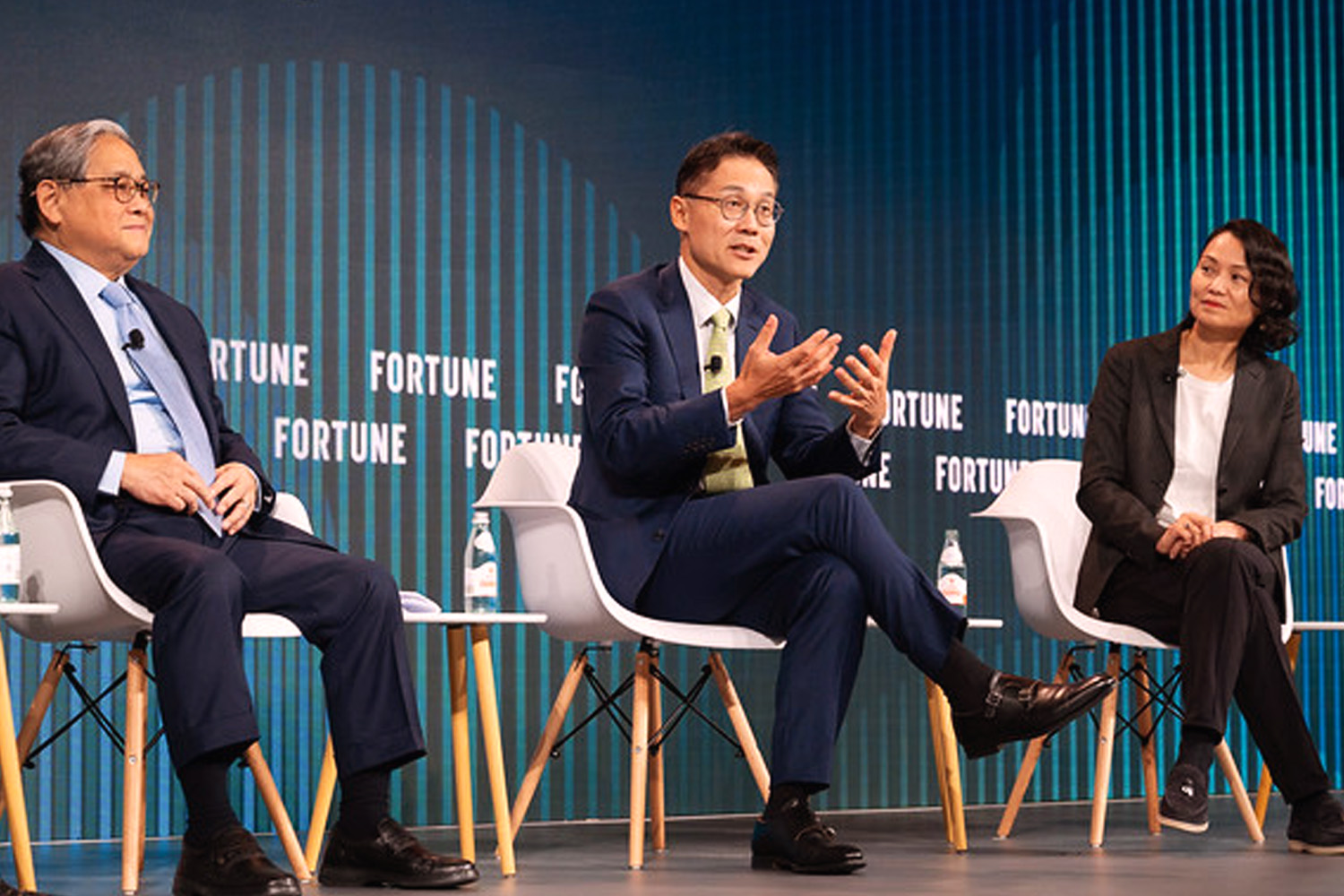
Joe Ngai’s journey from a cello-playing teenager in Hong Kong to a global business leader offers a unique perspective on the forces shaping our world. Born and raised in Hong Kong, his early life was deeply influenced by his musical pursuits. “I was a musician when I was growing up,” he says, “I was basically playing cello and for many years I thought that would be my calling.” His dedication saw him playing in numerous orchestras, even earning pocket money as a young teenager. This early exposure to performing with older, more experienced musicians, he believes, accelerated his maturity and fostered a more advanced way of thinking for his age, skills that would prove invaluable later in his career.
At 15, Ngai embarked on a new chapter, moving to New Hampshire in the United States for his final three years of high school. This transition he describes as a pivotal moment of character building. “It was the first time I saw snow, the first time that I experienced American football, frisbees, many, many things.” Moving from a comfortable, accomplished position in Hong Kong to an entirely new environment where he had to “restart” taught him to appreciate things he had previously taken for granted.
A Liberating Experience
His educational journey continued at Harvard, where he earned an undergraduate degree in economics, followed by a JD and MBA. Ngai reflects on his seven years at Harvard as a “very open time” and a “very liberating” experience. He particularly valued the curriculum’s flexibility and the intense academic environment. As an active student, he immersed himself in organising conferences and activities focused on China and Asia, topics that were gaining immense global interest at the time, particularly with China’s opening up and the discussions around China’s impending WTO accession.
This period, coinciding with the 1997 Hong Kong handover, provided him with a unique platform to engage with the intellectual debates surrounding globalisation and emerging markets, giving him an international overview: “Very early on, I was very informed with at least the intellectual debate on what was happening around the world.”
His time at Harvard also coincided with the dawn of the internet age. Ngai recalls receiving his first email account in 1993, a groundbreaking development that revolutionised communication and opened up new avenues for exploration. He was among the first generation users of early internet companies, embracing the experimental nature of the nascent digital world.
The Roaring 2000s in Asia
The transition from the academic world to the professional sphere, particularly on his return to Hong Kong in 2001, presented a new set of dynamics. Ngai joined McKinsey & Company in 2002, a period that he describes as coinciding with one of the fastest growing economic miracles in recent economic history. All the theoretical discussions from his university days about globalisation and China’s rise suddenly materialised into real life economic growth.
He witnessed firsthand the transformation of clients from mid-sized companies to global giants, with many overtaking companies that they had been learning from before.
“When you have growth, there are a lot of exciting things that happen,” he says, highlighting the palpable energy and excitement that permeated the region. This era of unprecedented growth in China, coupled with Hong Kong’s prosperity driven by mainland corporates and IPOs, created an incredibly dynamic business environment.
Savvy Navigation
However, the landscape has shifted considerably since those boom years. Ngai observes a distinct change in global connections, characterising them as definitely more difficult. The era of speedy globalisation has given way to growing protectionism. He attributes this shift to a widespread feeling that while prosperity has increased, economic inequality has also grown, both in developed and developing nations. Issues like immigration, technology, and geopolitical tensions have become more divisive.
Ngai points out a significant change in the relationship between business and politics. “Business for a long time steered very clear of politics, but not any longer.” With increasing geopolitical tension, business leaders are compelled to navigate a complex environment where politics directly impacts their operations. “Like it or not, you are part of it,” he says, underscoring the need for savvy navigation.
Gen AI and the Future of Work
A significant disruption is the rise of Generative AI. Ngai considers it one of the biggest game changers in both a positive and a negative way. He envisions its most significant impact in academia, transforming how papers are written, information is processed, and knowledge is retained.
While he is not pessimistic about AI leading to job losses, he is deeply concerned about the widening productivity gap it could create. “I’m a lot more worried that Gen AI will have a disproportionate effect on different types of people.” He foresees a great disparity between those armed with the right technology and those behind on it. While technology historically generates new, albeit different jobs, the onus is on individuals to adapt and acquire new skills. He stresses the importance for everyone to “understand and to leverage this because you’ll be left behind if you don’t.”
AI’s advance is close to home. Ngai’s employer of over two decades, McKinsey, is increasingly drafting proposals and making PowerPoint slides using the firm’s Gen AI platform, Lilli, which has sufficiently developed to take over some of the tasks previously performed by employees. Lilli’s AI agents can now create PowerPoint slides from simple prompts and ensure reports have the right tone through a tool dubbed “Tone of Voice.”
Still, Ngai sees AI not as a replacement for human work, but as a tool to enhance productivity. He suggests that 50% of daily tasks could change due to AI, as tools become available that enable faster synthesis and processing of information. Comparing it to the advent of Excel and PowerPoint, he believes Gen AI has the potential to propel industries and productivity further.
Craftsmanship vs The Easy Life
What about the implications of AI on conceptual thinking and the forming of a point of view? These qualities were traditionally highly prized in academic and professional settings. Ngai observes that AI’s ability to generate well-structured arguments through pattern recognition could commoditise these skills. As AI can quickly produce multiple points of view or good
questions, the deeper value of human thought might be diluted.
He fears that the ease with which AI can generate outputs might lead to a loss of motivation and perseverance. “Because it’s so much easier, people may lose the motivation and the ability to persevere to get an end result because it comes so easily.” Ngai, who prides himself on multiple drafts for his own writing, questions whether future generations, heavily reliant on AI, will invest the same effort. “The craftsmanship will be lost,” suggesting a potential loss of the joy, satisfaction, and meaning derived from the arduous process of creation. While the output may be “good enough and even better than if you put in the time,” the human experience of craftsmanship will almost certainly diminish.
Reimagining Education
This leads to a critical discussion about the future of universities and their mission. Ngai acknowledges that if education is viewed purely as a “transactional” product, solely focused on producing “better employees,” then significant changes are imperative. He humorously questions the lengthy durations of PhD programmes, suggesting that with AI, they could be significantly shortened.
However, he strongly advocates for a more holistic view of education. “Part of me still feels like labouring through something and spending time and not looking at those years in a purely transactional way. University is also about building of character, building of personality. It’s a social environment where you learn and you mature together.” Accelerating everything might lead to a loss of these crucial developmental aspects.
Efficiency vs Engagement
While acknowledging the need for modernisation, particularly in an age of diminished attention spans driven by platforms like TikTok, Ngai cautions against reducing education to mere efficiency. He believes that educators must evolve methods to retain student engagement, as the market for “long, laborious things” is shrinking. “But again, my own belief is that we’ve got to think a lot more than just purely transactional
on education.”
Ngai recognises the inherent challenges for established institutions to adapt, citing the natural inclination of many within academia to preserve what has been developed and to take pride in their legacies. Unlike businesses that face immediate market pressure, universities often have more time due to their longevity, brand, and reputation. This highlights a stark contrast with the Silicon Valley ethos, where “every single entrepreneur has their own experimental school,” underscoring the innovative and adaptable mindset prevalent in the tech world.
Shaping the Future
Joe Ngai’s reflections offer a vision of a world in transition. His insights, spanning his youthful journey as an incoming student in the US to his current role as a global business leader, serve as a timely reminder for individuals and institutions alike to embrace agility, critically assess their purpose, and, above all, to actively participate in shaping the future rather than passively being shaped by it. The challenge, as Ngai puts it, lies in finding ways to harness the immense potential of new technologies while safeguarding the enduring value of human craftsmanship, critical thinking, and the transformative power of a truly holistic education.