The hallowed halls of academia are undergoing a profound transformation, driven by an accelerating technological revolution and a shifting understanding of what it means to educate for the future. As Ron Kwok, a leading voice in CityUHK’s educational innovation, argues, the traditional model of university learning is evolving, with a clear mission now focused on “nurturing future leaders.” This isn’t just about imparting knowledge – it’s about cultivating skills, fostering interactive environments, and embracing the power of artificial intelligence to unlock unprecedented learning opportunities.
Interactive, Inspiring, Innovative
At the heart of this pedagogical shift are CityUHK’s “Three I’s”: Interactive, Inspiring and Innovative Learning. The emphasis is firmly on creating dynamic, engaging experiences that move beyond the passive consumption of information.
“We want to enable our students to be the business leaders of the future, so one of the most important aspects is how to communicate with different stakeholders,” says Ron.
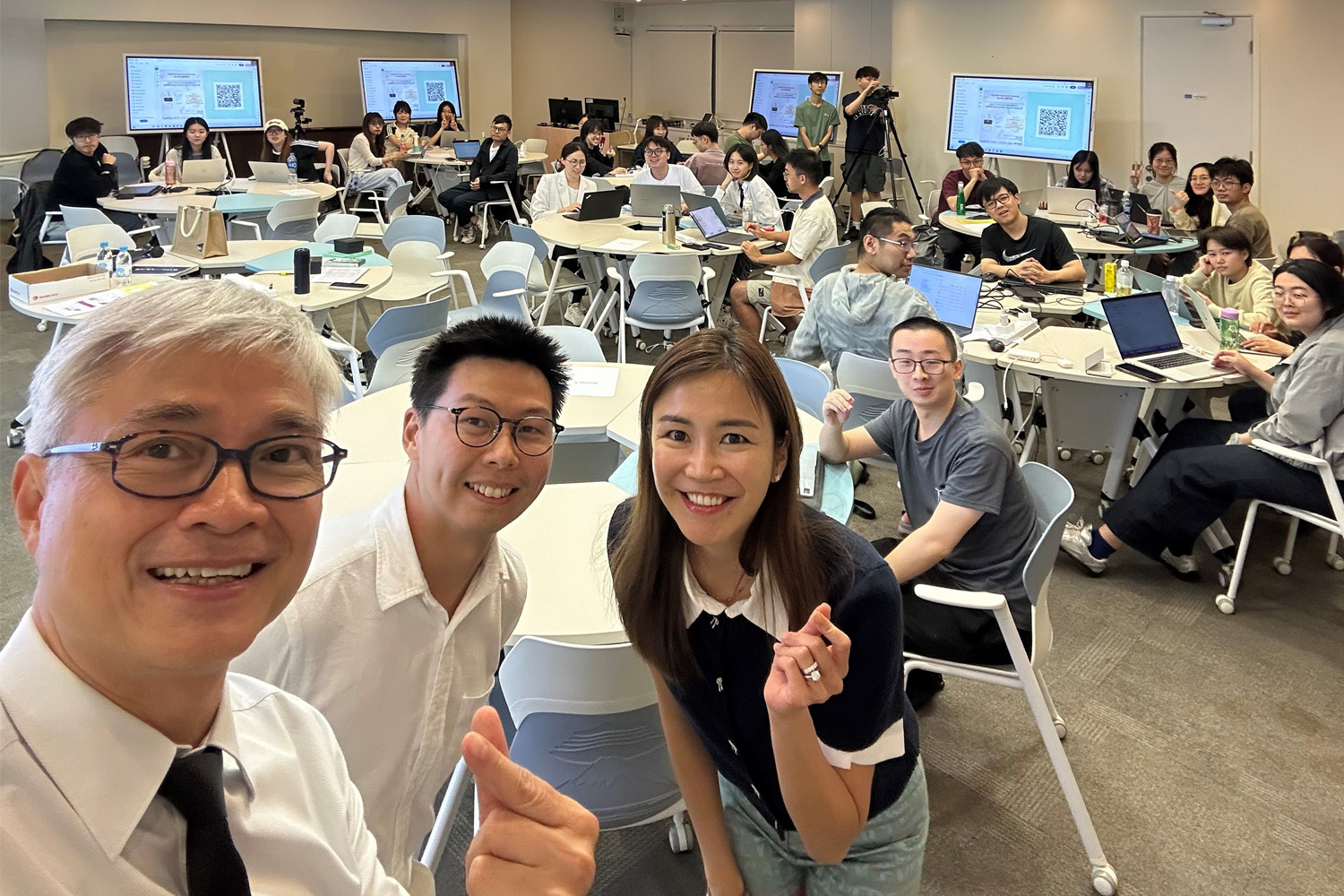
The paradigm shift is perhaps most evident in the re-imagining of the classroom itself. The days of the solitary lecturer delivering monologues to rows of students are being replaced by interactive, team-based learning environments. The classroom features round tables where small groups of students actively discuss problems, brainstorm solutions, and collaborate on projects, with the “lecturer” transitioning into a “facilitator” role – guiding discussions, posing questions, and encouraging peer-to-peer learning.
This move towards interactive learning isn’t a sudden, radical overhaul but a gradual, deliberate shift. As Ron explains, there won’t be a “Big Bang” when lectures disappear. “We’re going to see a continuum, moving from a high percentage of traditional lectures towards a more balanced, ultimately student-centric approach.”
Even the physical infrastructure of universities is adapting, with computer labs transforming into collaborative spaces where students bring their own devices, reflecting a blended learning model.
Why come to university?
The “product” of this interactive learning environment is not simply the absorption of
facts and the writing of essays, but the
outcome of rich discussions. Problems are posed, diverse perspectives are shared, and students engage in contested discussion to arrive at high-level solutions.
“The problem-based learning approach requires students to be well-prepared before coming to class, having already engaged with foundational material,” Ron emphasises.
The classroom then becomes a space for applying that knowledge, debating nuances, and presenting findings to peers, with the facilitator fostering a culture of mutual learning.
A critical question arises in this new landscape where information is constantly evolving: what constitutes “foundational knowledge”? Ron highlights the pivotal role of AI, specifically large language models (LLMs) like ChatGPT, in addressing this.
“Students can now leverage AI as a primary resource for acquiring foundational knowledge, freeing up class time for higher-order thinking and collaborative problem-solving.”
This doesn’t negate the need for human interaction; rather, it elevates it. The human element comes into play in validating and justifying the information provided by AI, fostering critical thinking, and engaging in discussions that refine understanding.
Personalised Learning Partner
A particularly innovative concept Ron introduces is the course-specific chatbot.
“Imagine a learning environment where each student group has access to a dedicated AI companion, trained on all the course materials, lecture notes, and even relevant external links.”
This AI course-specific checkpoint acts as a personalised learning partner, allowing students to ask fundamental questions, explore topics in depth, and analyse problems with AI guidance before coming to class. The tailored approach addresses the potential overwhelm of general LLMs, ensuring that the AI assistance is directly relevant to the specific learning objectives of
the course.
The strategic deployment of AI in Hong Kong universities should be considered from a macro perspective. The University Grants Committee (UGC) plays a guiding role, encouraging the adoption of AI in formative assessments (ongoing learning and feedback) while maintaining traditional methods for summative assessments (final exams). At CityUHK this policy-making is driven by units like the Talent and Education Development Office (TED) under the leadership of Professor Gerhard Petrus Hancke, of the Department of Computer Science. Their mission extends beyond policy to actively recommending and supporting the implementation of immersive learning technologies, such as augmented and virtual reality, to enhance the learning experience.
Patentable Ideas
Ron provides a compelling example of how the future might look from his own course, “Innovation and Technology Entrepreneurship.”
“The Minimum Viable Product is like a prototype. When the angel funders look at it, the students have to sell its advantages. That’s where good communication is vital.”
The objective is to equip students with the skills to develop fundable proposals for startups. A critical success factor for such proposals is the integration of a patentable idea – something many business students may lack deep technical expertise in. This is where the course-specific checkpoint, tailored with the university’s own patent database (CityUHK boasts a significant number of US patents), becomes invaluable. Students can interact with the AI to understand complex patent concepts, explore existing CityUHK patents, and connect with patent owners (professors) to refine their proposals. This bridges the gap between academic knowledge and practical application, allowing students to develop Minimum Viable Products that are grounded in robust technological understanding.
Integration of Academia into LLMs
Another crucial, contemporary concern is the potential marginalisation of academia in the age of widespread LLMs. Historically, academic research has been published in proprietary journals, often inaccessible to the broader public.
“Although it’s true that ownership of intellectual property is important, accessibility is equally vital, especially in the context of AI,” says Ron.
The genuine academic success factor, he emphasises, is about the impacts to our lives and wider communities. The more widely accessible academic work is, the greater its potential for citation and real-world influence.
“The integration of academic content into LLMs should be welcomed as it amplifies the reach and impact of scholarly work,” he says.
Ron believes LLMs would be one of the promising channels to bring research and patents to life, connecting academia to people.
Speed Learning
Finally, Ron notes the essential differences between the rapid development of technology
and the step-by-step learning process in education. While acknowledging the long-established structure of multi-year degrees and traditional assessment methods, Ron envisages that a revolution, albeit a gradual one, is possible.
“I can see a future where highly talented students might accelerate their degrees, completing programmes in a fraction of the time, or even pursuing simultaneous undergraduate and graduate studies.”
This “self-directed learning” model, he believes, would be facilitated by robust AI infrastructure, allowing students to “taste” and deeply understand courses even before formally enrolling.
A Future of Student Products
The implications for assessment are profound. If foundational knowledge can be acquired and refined through AI, and higher-order skills are developed through interactive, problem-based learning, then assessment should not be limited to traditional pen-and-paper essay examinations. The focus would shift to the products students can create – viable business proposals, innovative app ideas, or tangible prototypes, reflecting a real-world application of their learning. Ron’s vision points towards an academic future where universities are not just repositories of knowledge, but dynamic hubs of innovation, where AI empowers students to become proactive, self-directed learners, equipped to lead in an increasingly complex and rapidly evolving world. The future of education, as Ron sees it, is collaborative, technology-driven, and relentlessly focused on empowering the next generation of global leaders.